The 90-Day Start to Small Business Succession Planning: Transition Planning, Tips and Strategies

Dylan Gans
May 5, 2025 ⋅ 7 min read
I used to think succession planning was something you did when you were old. Or when you were rich. Or when your business had a whole HR department and a board to worry about it.
Then I started talking to small business owners who had gotten sick unexpectedly, received an unsolicited offer they weren't ready to evaluate, or watched a key partner walk out the door without a buyout structure in place. They weren't unprepared because they didn't care. They were unprepared because no one had ever made the process feel real or manageable for a business their size.
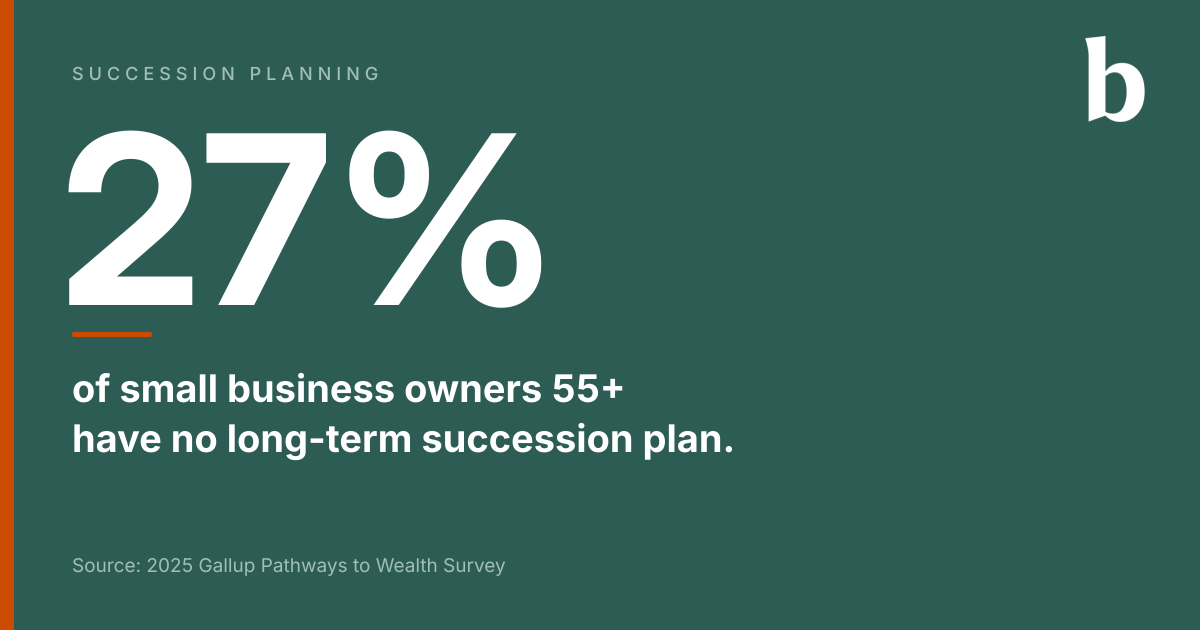
The advice below is what I'd give them, and what I'd tell any owner thinking one to ten years ahead.
Why Small Business Succession Planning Can't Wait (Even If You Plan to Work Forever)
Here's the thing no one says out loud: durable businesses are still one surprise away from disruption. Illness, burnout, a divorce that suddenly makes your equity a marital asset, an offer from a competitor that arrives before you're ready—any of these can force decisions faster than you expect.
When that happens to owners who haven't done any transition planning, I watch the same things happen over and over. Rushed decisions. Valuations that disappoint. Family conflict that didn't have to happen.
Planning now doesn't mean you're leaving. It means you're staying in control of the timing, the price, and what happens to the people who helped you build this.
How to Think About Succession Planning for Small Businesses (and Who Actually Needs It)?
When I explain this to owners, I break it into three layers that have to work together:
Ownership transfer: who ends up holding the equity, and how does money change hands?
Leadership transition” who makes day-to-day decisions, and does that person have the judgment to do it well?
Operational continuity” can your customers keep getting what they expect, without you personally holding every relationship together?
Every business owner needs to think about all three, whether you're a sole proprietor, a multi-partner firm, or a family company where the next generation is already working alongside you.
Family Business Succession Planning: The Questions People Avoid
If you run a family business, the conversation gets more complicated in very specific ways. I've seen this play out enough times to say clearly: the hardest part isn't the legal structure. It's the human part.
Who actually wants to run the business versus who feels obligated? Does capability align with interest? And how do you transfer ownership fairly across multiple heirs when some are involved in the business and some aren't?
Families that do this well typically do two things. They separate ownership from management — meaning you can receive economic value without having to make decisions, and vice versa. And they set up some form of formal governance, even if it's simple, so the business isn't held hostage to family dynamics every time a big decision comes up.
These conversations are uncomfortable. That's exactly why having a neutral partner early in the process makes such a difference.
How Long Does Business Succession Planning Actually Take?
The honest answer: longer than you think, and the extra time is usually worth it.
The ideal runway is five to ten years. That sounds like a lot, but it's not time only spent doing paperwork. It's the hours you put in cleaning up your financials, reducing owner dependency, and positioning the business so a buyer or successor sees what you see in it.
A shorter runway still helps. Even 90 days of focused effort—writing your emergency plan, identifying successor candidates, getting a baseline valuation—changes your position dramatically.
The worst time to start is when you have no choice. By then, you're reacting, not choosing.
Your Options: How to Transfer a Small Business (And What Each Path Actually Looks Like)
There's no single right path. The right one depends on what you're optimizing for: control, price, speed, or impact on the people you've worked with. Here's how I think about each option honestly.
Transfer to a family member
Works when interest and capability genuinely align, not just when you want it to. If you're planning to transfer the business to a child or another family member, document expectations early and get in front of the tax and funding questions before they become surprises. Gift taxes, estate considerations, and how the successor actually finances the purchase all need to be modeled in advance.
Management buyout or sale to a co-owner
Often the smoothest cultural handoff, because the buyer already knows the business. Financing is usually a blend: seller notes, bank debt, profit-share structures, sometimes earn-outs. I like this path for owners who care about continuity and aren't purely maximizing sale price.
Sale to an outside buyer or strategic acquirer
This one gives you the most exposure to market pricing and can accelerate growth for the business if the acquirer brings resources. It also requires the most preparation: clean books, documented processes, and a clear story about why the business performs.
ESOP or employee buy-in
A structured path that can balance your financial goals with the legacy you've spent years building. It's not the right fit for every business, but for the right situation, it lets your people become the owners. The National Center for Employee Ownership has a good neutral overview if you want to understand the mechanics.
Orderly wind-down and asset sale
A legitimate, dignified choice when there's no suitable successor and the business isn't positioned for a sale.
Transition Planning in Practice: Preparing People, Not Just Documents
The plan is only as good as the human preparation behind it. I think about transitions in four phases: planning, preparation, handover, and post-handover support. Moving through phases together—rather than handing over the keys all at once—reduces risk and builds confidence in the person stepping up.
The tools that actually work include job shadowing for transferring judgment, delegated projects with real authority, leadership coaching focused on specific gaps in your model. And early, honest communication with employees, customers, lenders, and family because silence creates rumors.
For the next 90 days, here's where I'd start: identify your top two successor candidates, write your emergency owner memo, build a single-page transition roadmap, and schedule the three conversations you've been putting off. Then set a monthly review to update the checklist. That's enough momentum to change your position significantly.
Succession Planning Mistakes I See Small Business Owners Make
Most owners don't fail because they lack structure. Here are the risks I watch for:
Everything depends on the owner. Customers call you directly. Processes live in your head. The business can't function without you, which means it can't be valued without you, either. Fix one dependency at a time.
Outdated or messy financials. Buyers and lenders underwrite what they can verify. If your books don't tell a clean story, neither will your valuation.
Choosing successors based on emotion. The most loving thing you can do for a family member is be honest about whether they're ready. Run trial projects. Surface the criteria. Use outside facilitation if the conversations get stuck.
Avoiding honest conversations with key employees. The people most likely to leave during a transition are the ones who feel left out of it. Communication doesn't have to reveal everything, but it should demonstrate that you're thinking about their futures too.
Waiting too long to start. I've saved this for last because it's the one that makes all the others worse. Every month you wait narrows your options.
Final Thoughts
I'll leave you with the one thing I'd say to any owner who's been putting this off: the cost of waiting isn't abstract. It shows up in your valuation, in your options, and in how much control you actually have when a decision gets forced on you.
You built something real. Now is the best time to protect it.